
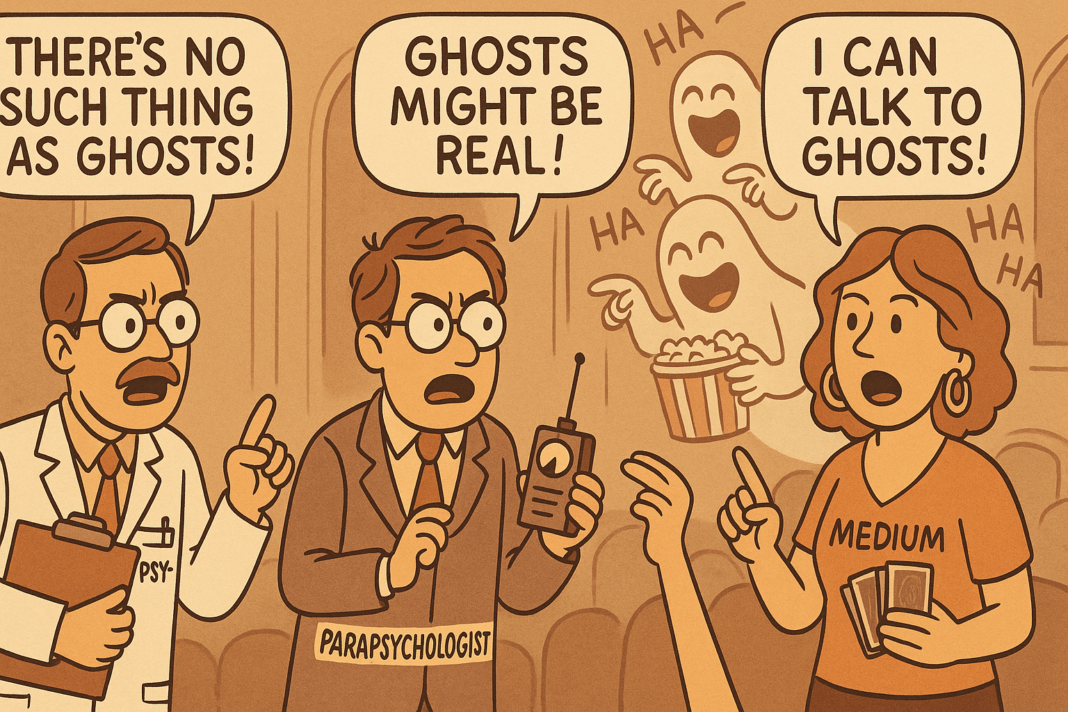
(Authors note: During the preparation for this article, I interviewed several psychiatrists, a medium, and a parapsychologist. Below are short takeaways from those interviews.
Psychiatrists say our brains are built to over-detect patterns and agency—especially in the dark and under stress. Rustles become footsteps; static becomes words. Once a story is emotionally invested, cognitive dissonance and confirmation bias keep it alive, while grief and community identity give it purpose. In plain terms: ghost stories persist because they soothe loss, bind groups, and turn random noise into meaning.
Parapsychologists counter that a small residue of cases doesn’t fit those explanations. Meta-analyses of Ganzfeld and presentiment studies report above-chance “psi-like” results, and field cases sometimes include veridical details witnesses shouldn’t know. Their claim isn’t “every legend is true,” but that some experiences look like genuine anomalies—misread by skeptics as mere error and by fans as full-blown hauntings.
Mediums go further: to them, the best cases are not effects but people—communicators who deliver specific, checkable facts (names, private jokes, “drop-ins”) under blind conditions. They distinguish “intelligent” hauntings (a responsive personality) from “residual” imprints (a place memory) and argue that evidential hits plus healing outcomes explain why some stories outlive every debunking.
(Important note: I was once a practicing magician, working at the Coney Island boardwalk as a teenager. I have seen paranormal investigations at work. I participated in several.
As a magician, I was compelled to recreate those results through the craft of stage magic. While in no way do I believe that all paranormal investigations are rigged, Mike Mazza and his team were the epitome of propriety. none- the-less here is a magician’s view.)
And here’s how investigations can get quietly steered:
prime the group (“announce any change”), then script the gadgets (“one beep = yes”). Spirit boxes turn radio hash into words once a yes/no code is set; EMF spikes near wiring become “replies” on cue; Faraday pouches, timing, and camera edits curate what “counts.” With expectation, simple rules, and selective framing, you can make the tech appear to agree with almost any narrative—proof that in ghost hunting, whoever controls interpretation often controls the evidence.
Closing thoughts-
I’ve chased a lot of midnight stories, and most of them look different in daylight. But here in Monmouth County, the daylight blinks—like the Sandy Hook Light, one tired eye that’s seen too much—and the footprints don’t quite wash away. Call it nerves, call it noise, call it the dead clearing their throats; the tape still rolls, the EMF still hiccups, and some kid on a back road still swears the girl in the mirror smiled first. So, we file the report, we keep the coffee warm, and we walk the old routes one more time—King’s Highway, the Spy House lawn, the battery that hums when the wind shifts—half skeptic, half confessor, all ears.
Because if there’s one thing I’ve learned in the small hours, it’s this: the past doesn’t need your belief to follow you home. It just needs you to look over your shoulder.