The Mad Man on the Beach
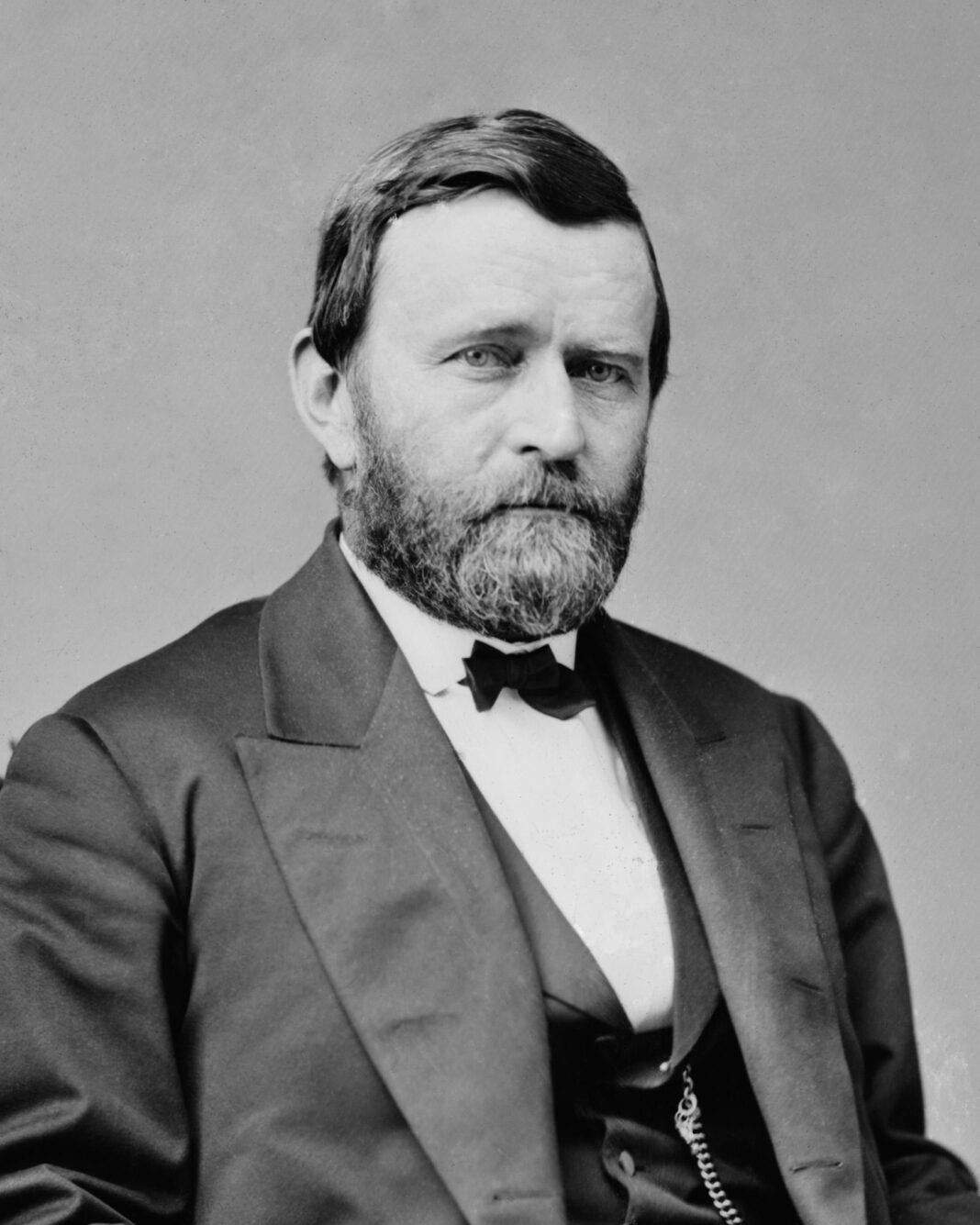
It was August 1869 in the Elberon section of Long Branch, NJ. Sam Grant was awake earlier than usual. When he was in Washington DC, he generally woke at 7:00 AM, ate breakfast, and then took a walk around Washington, D.C. Today was different. It was going to be a big day, maybe one of the biggest of his presidency. He was in the cottage’s livery, working on hitching up his two horses to the carriage. This early in the morning allowed him to hitch his horses, Bill and Tom, himself, without a herd of people insisting that they do it for him. The benefits of being the President, he supposed. He hated it. The fact was that Sam Grant loved horses.
During the Civil War, after the Battle of the Wilderness, it was reported that he wept in his tent over the deaths of so many horses. There were, indeed, a significant number of horses and mules killed during the battle. But 17,666 Union soldiers and 11,033 Confederate soldiers were casualties, with the Union suffering more fatalities. General Sam Grant privately cried for them all.
As he hitched Bill and Tom for whom he had great affection, Grant chuckled softly as he thought about how everyone around him referred to him as Sam. His cabinet, members of the Congress and Senate with whom he was acquainted, even his family called him Sam. This nickname came about because of an error in his name registration when he entered the Academy at West Point, where his name was recorded as Ulysses S. Grant instead of his birth name, Hiram Ulysses Grant. His Classmates at West Point initially called him “Uncle Sam” Grant, derived from his initials U.S. Later, they shortened it to simply “Sam.”
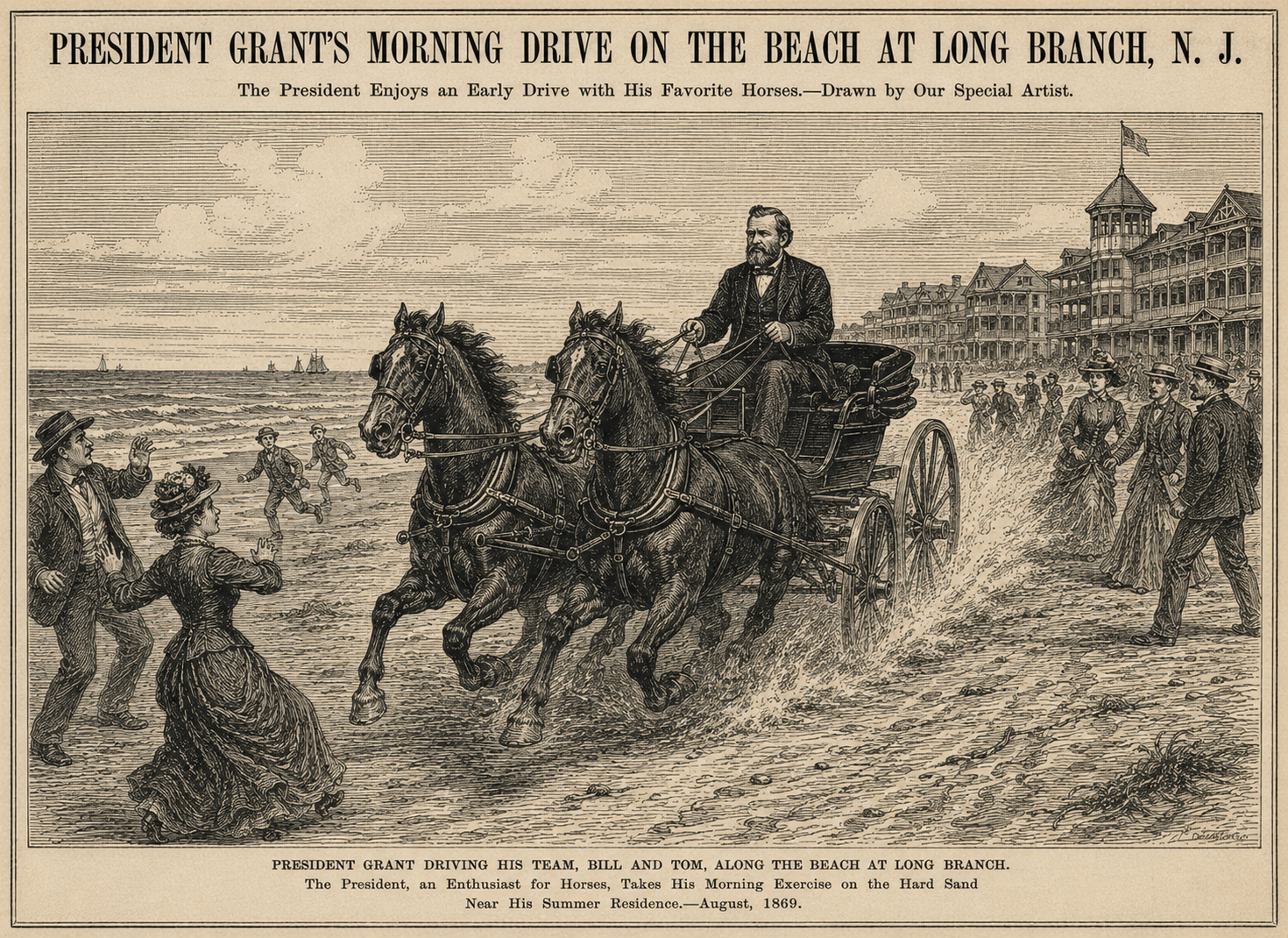
“OK, Boys, time to run,” Sam said as he climbed into the carriage. Taking the reins, he led Bill and Tom to the hard wet sand on the beach. They paused as Grant surveyed the beach.
“Good not a lot of people.” He said to the horses. “We’ll race to that hotel up there and trot
back. You fellas ready?” Bill and Tom were, literally, chomping their bits. Grant gently touched the reins, and they were off first at a trot, then a gallop, and then at a full gallop.
Sand sprayed from the back wheels leaving an aerosol-like wake. Onlookers gasped and hastened out of the way of the mad man driving a team on the beach. Some thought that the man looked familiar.
At the hotel, they slowed down and turned back towards the cottage, trotting slowly. The horses and the man exhilarated at the morning exercise. Sam said “Bill, Tom, I am a firm believer that everyone needs to get up and move regularly to stay fit and ready for duty. That’s why we do it. Besides,” Grant laughed, “I know that the three of us live for this!” As the trio moped along the beach, onlookers who had watched them streak past a few minutes earlier got a good look at that “Mad Man”. A woman exclaimed to her husband, “That mad man looks like President Grant!” The man in disbelief said, “Agnes, that mad man IS President Grant.”***
When they, Bill, Tom and the President, pulled into the livery, the attendants had just arrived to work. They immediately hurried to help the President down from the high seat of the carriage and curry the horses. Sam waved them away saying, “The day comes that I can’t take care of my own horses, that’s the day I don’t deserve them.” He unhitched them and began currying them even before the groomsman could insist that they help. Grant finished and gave Bill and Tom their breakfast. Then he went up to the cottage.
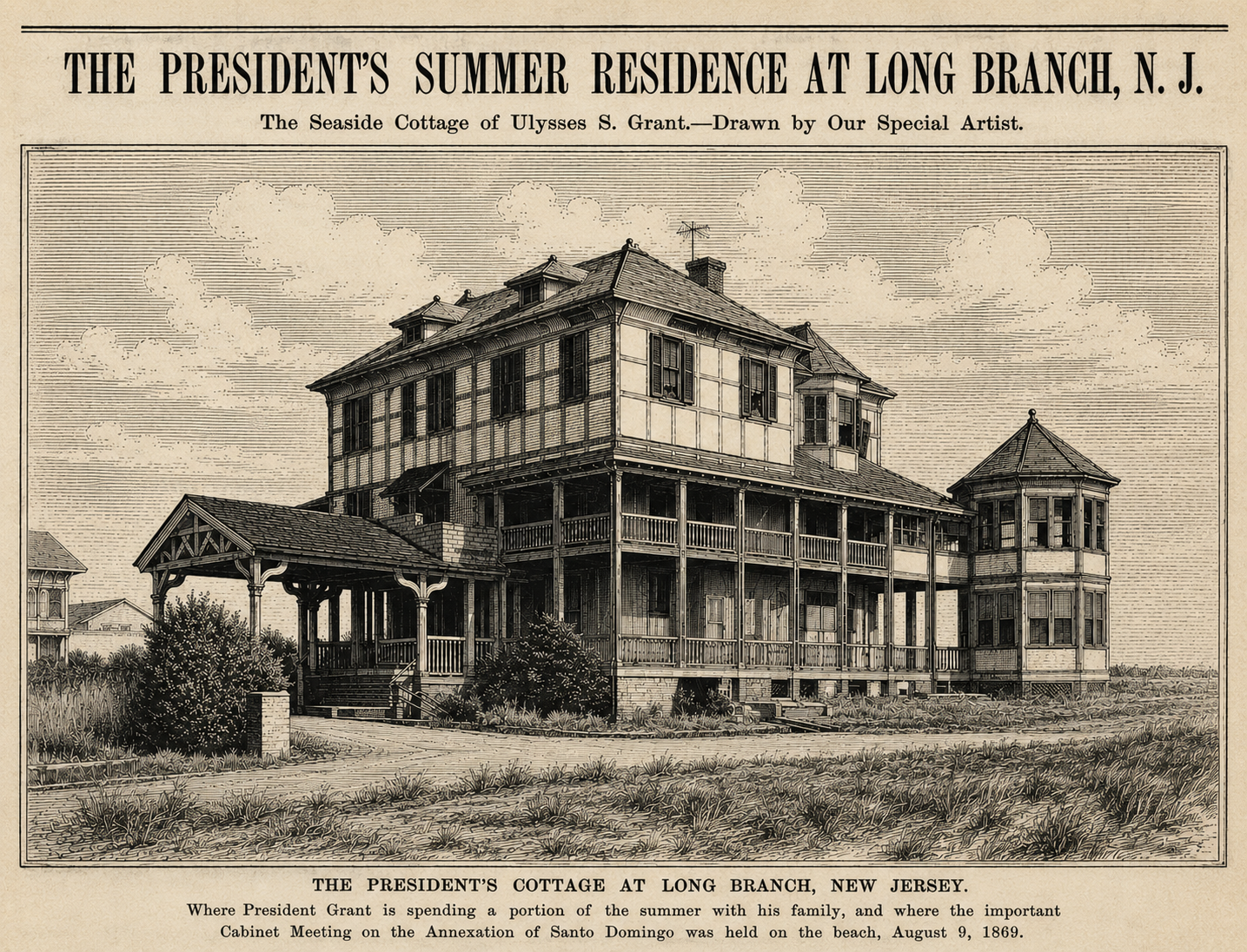
“Sam, do you think it wise that you hold your cabinet meeting here at the beach?” His wife Julia asked. “Not at the beach, my darling…on the beach. I have a lot to tell the cabinet and holding a meeting on the beach gives me a tactical advantage.” “Santo Domingo, Sam?” Julia asked. “Exactly, but now they call it the Dominican Republic,” Grant replied, his eyes once more the eyes of a General. “Julia, the United States of America needs a naval base in the Caribbean to protect our flank. The negros freed during the war need a haven. They are brutalized and oppressed even though Nathan Bedford Forest dissolved that Ku Klux abomination. Maybe the Dominican Republic becomes a state…” He set off to change for the meeting.
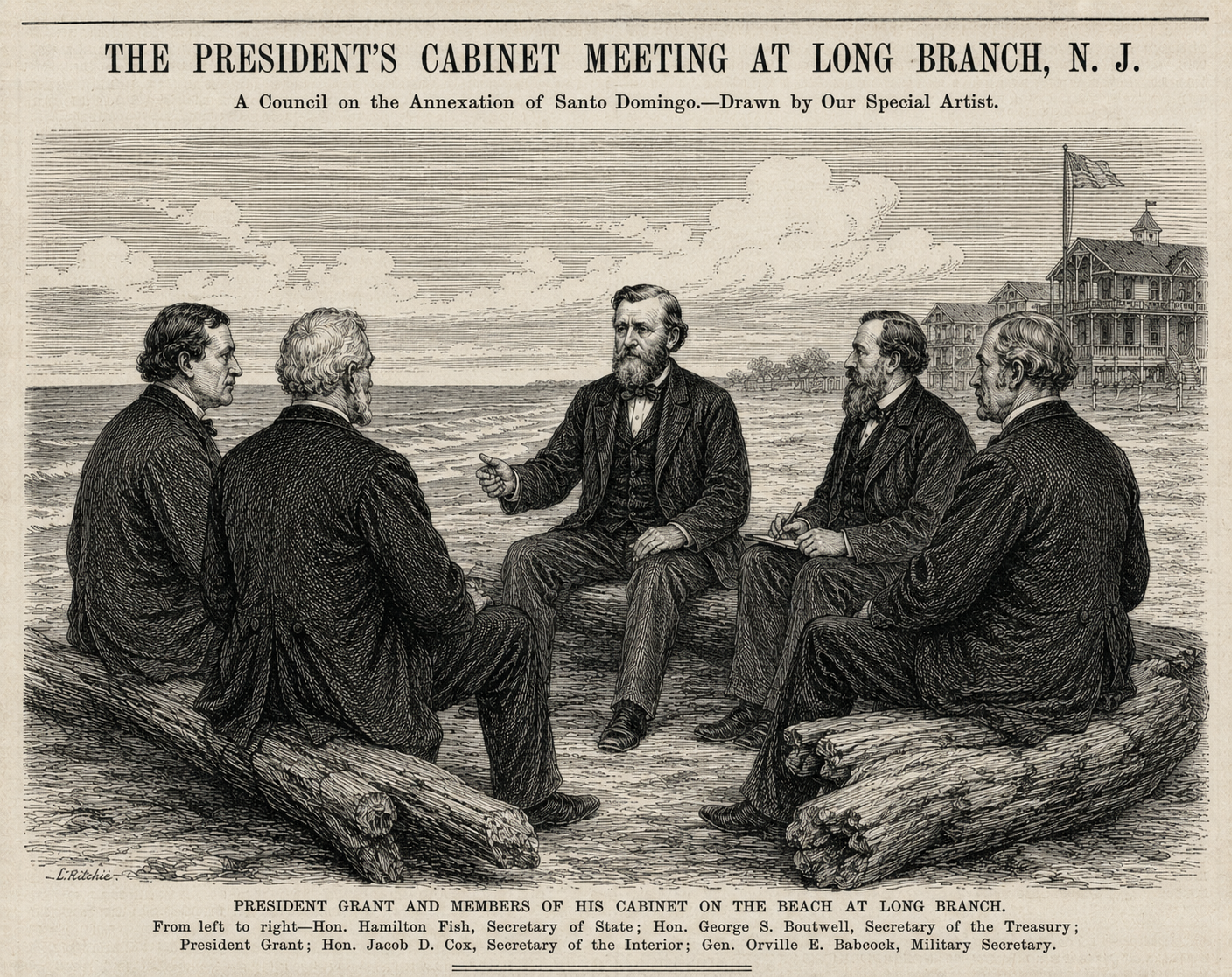
When they arrived (Hamilton Fish – Secretary of State, George S. Boutwell – Secretary of the Treasury, Jacob D. Cox – Secretary of the Interior, General Orville E. Babcock – Grant’s Military Secretary & Special Envoy), they were ushered outside rather than into the cottage’s great room. They walked to the beach and found Grant sitting on a driftwood bench looking out at the ocean. Each man, in turn, sat down on a driftwood bench, imagining that Grant built them himself.
Grant greeted each man by name, and they exchanged pleasantries. They all took a seat on the roughhewn driftwood benches. Sam brought the Cabinet meeting to order.
The Driftwood Cabinet
The surf rolled steadily behind him, low and rhythmic, on that Elberon beach. Gulls wheeled
lazily overhead. The morning haze had begun to burn away, leaving the sea a hard blue-gray under the August sun.
Hamilton Fish shifted uncomfortably on the driftwood bench. Secretary of State or not, there was something profoundly strange about discussing matters of state with sand working its way into one’s polished shoes.
Grant sat silently for a moment, his hands folded atop his cane, studying the horizon before
speaking. “Gentlemen,” he said quietly, “the war settled the question of the Union. But it did not settle the future of the Republic.” The men glanced at one another.
Grant rarely wasted words.
“The Caribbean,” he continued, “is the key to the Gulf. Whoever controls those waters controls trade, naval movement, and ultimately influence in the hemisphere.”
Babcock nodded eagerly. Fish did not.
Grant reached into his coat pocket and removed several folded papers.
“Santo Domingo.” The name hung in the sea air.
“The Dominican Republic,” Grant corrected himself. “President Báez is prepared to negotiate annexation.”
Boutwell raised his eyebrows. Fish stared directly at Grant now.
Grant handed the papers to Babcock, who passed copies among the men. The only sounds for several moments were the ocean and the rustle of paper.
Fish’s face tightened as he read.
The treaty outlined a proposal for the United States to annex the Dominican Republic, assume portions of its debt, and lease Samaná Bay as a permanent American naval station.
Fish looked up slowly.
“Mr. President…”
Grant lit a cigar.
“General Babcock has already visited the island,” Grant said. Fish blinked.
“Visited…in what official capacity?”
Babcock opened his mouth, but Fish’s eyes remained fixed on Grant. Grant exhaled smoke.
“He represented my interests.”
Fish removed his spectacles. “With respect, sir, treaty negotiations are the responsibility of the State Department.”
Grant’s expression remained calm.
“And they are now before the State Department.” Fish looked back down at the papers.
There it was.
The thing was already moving.
The outlines of policy.
Commitments implied.
Promises perhaps already made.
Jacob Cox watched silently for a moment before finally speaking. “But Mr. President…”
Grant turned toward him.
“Has it been settled, then, that we want to annex Santo Domingo?”
The wind shifted.
No one spoke.
Fish looked down.
Boutwell stared out toward the surf.
Babcock suddenly found the horizon fascinating.
Grant puffed hard on his cigar.
The question lingered in the salt air.
Years later, Cox would remember that exact moment.
The President of the United States sitting on a driftwood bench on a New Jersey beach, cigar smoke curling around his beard, suddenly looking less like a conquering general and more like a man caught revealing his hand too soon.
Grant finally broke the silence.
“I believe,” he said carefully, “that Santo Domingo offers advantages too important to ignore.”
He leaned forward.
“A naval base at Samaná Bay gives us reach throughout the Caribbean. Protection against
European interference. Security for future trade.”
He paused.
“And perhaps most importantly…”
Grant looked directly at Fish.
“…a refuge.”
No one needed clarification.
Grant had commanded Black troops during the war. He had seen their courage firsthand. He had also seen what awaited many of them afterward.
Night riders. Burned churches. Lynch mobs.
Former Confederates reclaiming power county by county across the South. “Nathan Bedford Forrest may claim the Klan is dissolved,” Grant said coldly, “but the violence has not dissolved with it.” Grant continued. “The freedmen deserve opportunity somewhere beyond the reach of terror. Santo Domingo could provide that.” Fish folded the treaty carefully. “Or,” he said quietly, “we could inherit revolution, instability, and every debt on that island.”
Grant smiled faintly.
“That is why I invited you to Long Branch instead of Washington, Hamilton. Men think clearer with salt air in their lungs.” Fish actually laughed once at that. A short, exhausted laugh. Then he shook his head.
“Mr. President, the Senate will not simply accept this because you wish it.” Grant looked toward the ocean again.
“The Senate opposed the war too, at times.”
Fish replied carefully. “This is not war. This is empire.”
That word settled heavily over the driftwood circle.
Empire.
For a moment, even Grant seemed to consider it.
The former tanner’s son from Ohio.
The mud-soaked general from Shiloh.
Now sitting barefoot in beach sand discussing whether the United States should absorb
another nation.
Grant stood slowly.
The others rose with him. He brushed sand from his trousers. “Gentlemen,” he said, “history rarely waits for comfortable circumstances.” Fish tucked the treaty into his coat.
The meeting was over.
But the argument was only beginning.
Within months, the annexation proposal would ignite one of the fiercest political battles of Grant’s presidency. But on that August morning in Elberon, with the Atlantic rolling endlessly beside them, the future still seemed possible. Grant remained standing after the others departed.
Fish and Boutwell walked slowly back toward the cottage, deep in private conversation. Babcock followed, carrying the treaty papers beneath his arm.
Cox lingered briefly.
“Mr. President,” he said quietly, “you know they will fight you on this.”
Grant nodded “They fought me at Donelson too.” ***
Cox smiled faintly.
“That is not exactly reassuring.” Grant chuckled.
“No,” he admitted, “I suppose it isn’t.” Cox tipped his hat and departed.
Grant remained alone facing the ocean.
Perhaps thinking about the Caribbean.
Perhaps thinking about Reconstruction.
Or perhaps simply listening to the surf.
Because for all the burdens of the presidency, Long Branch offered him something Washington never could. Quiet. At least for a little while.
The President’s Santo Domingo plan collapsed in the Senate in 1870 beneath accusations of
imperial ambition, executive overreach, and political secrecy. Yet over the next three decades, the world changed in ways Grant had already foreseen. Steam and steel replaced wooden fleets. The Panama Canal transformed from fantasy into inevitability. Naval strategist Alfred Thayer Mahan argued that global power belonged to nations controlling coaling stations and sea lanes. Suddenly, the Caribbean became the strategic front door of the United States.
By the time America secured a permanent naval lease at Guantánamo Bay in Cuba in 1903, much of what Grant had envisioned from the driftwood benches of Long Branch had become accepted military doctrine. The geography had changed. The politics had changed. But the strategic idea remained unmistakably Grant’s.
*****************************************************************************
Source note: Portions of the cabinet dialogue are drawn from the later recollections of Jacob D. Cox regarding Grant’s Dominican Republic annexation discussions and from documented historical details surrounding the proposed Santo Domingo treaty and Grant’s summers in Long Branch, New Jersey.
*** Annotation – Racing down the beach
In 1870, Grant was stopped by DC Metropolitan Police Officer William West, a formerly
enslaved man and Civil War veteran. West stopped Grant on 13th Street for racing his horses at dangerous speeds and let him go with a warning. The very next day, West caught the president racing again and officially placed him under arrest. Grant was taken to the police station and posted a $20.00 bond, which was later forfeited when he did not appear for trial.
He was entirely gracious about the arrest and praised the officer for doing his civic duty.
President Ulysses S. Grant was the first sitting U.S. president to be arrested.
*** Annotation – Fort Donelson (1862)
Fort Donelson, Tennessee, was the site of one of General Ulysses S. Grant’s first major Union victories during the Civil War. In February 1862, after days of brutal winter fighting,
Confederate commanders demanded terms. Grant famously replied that he would accept “No terms except an unconditional and immediate surrender,” earning him the nickname “Unconditional Surrender” Grant.
The victory secured Kentucky for the Union and opened Tennessee to Federal invasion, and elevated Grant to national fame. When Grant tells Cox, “They fought me at Donelson too,” he is recalling a moment when overwhelming political and military opposition ultimately gave way to success through persistence and resolve.