Discover the birds of Sandy Hook!

Join the American Littoral Society’s expert birder, Dan Burgoyne for an evening of birding within various habitats around Sandy Hook!
First, we will meet at our office and explore some of the maritime forests south of Guardian Park. Here we may encounter several species including american redstarts, ospreys, and northern yellow warblers to name a few!
Then, we will drive guests down to the Spermaceti Cove boardwalk. This will allow us to scan the bayside salt marshes for waterbirds such as royal terns, great blue herons, great egrets, and black-bellied plovers before sunset!
Perfect for birders of all experience levels.
Walking Distance: 1.2 miles (round trip)
Contact: [email protected] for more information
Lear and his colleagues analyzed responses from more than 130,000 people aged 35-70 in 17 countries. Participants were asked about their levels of physical activity, then they were followed for nearly seven years.
The conclusion was that 1 in 20 cases of heart disease and 1 in 12 premature deaths could be prevented if everyone met World Health Organization guidelines. WHO recommends that adults do at least 150 minutes of moderate-intensity exercise a week. This is a mere 2.5 hours a week that could bring long term health benefits. It’s time well spent when we invest in our long term health.
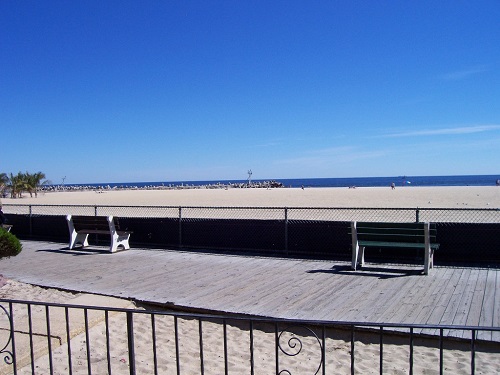 Lucky for us, the Jersey Shore has many beautiful walking trails and beaches. Why spend time on a treadmill when you can enjoy the outdoors? We’ve listed Five local spots that make taking a walk into a mini-vacation!
1- Boardwalks– They are numerous here at the Shore and one is guaranteed to be the perfect length for your walk.
2- Manasquan Reservoir- There is a 5-mile perimeter trail or a 1-mile interior Nature trail.
3- Edgar Felix Memorial Bikeway– A 5.2 long trail starting in the town of Manasquan and ending at Allaire State Park.
4- Sandy Hook Multi-Use Pathway- An 8.5-mile path with stunning ocean views and beaches leading to Fort Hancock.
5- The Henry Hudson Trail– A tree-lined 24-mile pathway mostly paved and flat.
We live in the perfect place to power walk! Grab your sneaks and head out to your favorite place at the Shore!
]]>Join the American Littoral Society’s expert birder, Dan Burgoyne, for a morning of birding along the coast as we explore Sandy Hook’s rich and diverse habitats.
We’ll walk through forests, marshes, and shoreline areas in search of shorebirds, songbirds, and more. Along the way, we’ll share bird ID tips and highlight that Sandy Hook is an important habitat for wildlife.
Perfect for birders of all experience levels!
Meet at 7:00 a.m. at the Littoral Society office
Walking Distance: 1.5 miles round trip, dense sandy terrain
Contact: [email protected]
Please bring binoculars, sunscreen, bug spray, a water bottle, snacks, and appropriate footwear or hiking shoes for dense sandy terrain.
Weather & Cancellation
Programs may be canceled for safety due to hazardous weather.
Participants will be notified by the end of the prior business day.
If the Society cancels, we’ll work with you to reschedule or transfer your booking.
Cancellation Policy
- 7+ days before: Full refund
- 2–6 days before: 50% refund
- Less than 48 hours: No refund
Questions? Contact us; we’re happy to help!
Saturday, August 15, 2026
7:00 a.m. – 9:00 a.m.
Meet at the Littoral Society Office
18 Hartshorne Dr,
Gateway National Recreation Area
Sandy Hook Unit
Highlands, NJ 07732
Member – $10 per participant
Nonmember – $20 per participant
Discover the Coastal Wildlife at Sunset Seining!
Join us for an evening of hands-on discovery as we explore the diverse wildlife that calls our coast home.
We’ll begin on the Society’s front porch, then take a short walk together to a cove on Sandy Hook Bay for a guided seining adventure. Participants will help pull a seine net through the bay and experience the thrill of discovering fish, crabs, and other fascinating marine creatures.
Thursday, August 13, 2026
6:00 p.m. – 8:00 p.m.
Meet at the Littoral Society Office
18 Hartshorne Dr,
Gateway National Recreation Area
Sandy Hook Unit
Highlands, NJ 07732
Member – $10 per participant
Nonmember – $20 per participant
Member – $10 per participant
Nonmember – $20 per participant
Please wear clothes and shoes you don’t mind getting wet!
Meet at 6:00 p.m. on the porch of our building:
18 Hartshorne Drive, Highlands, NJ 07732
If you’re running late, head straight to the cove.
Contact: [email protected]
 Sunset at 8:30 pm
–
Weather & Cancellation
Programs may be canceled for safety due to hazardous weather.
Participants will be notified by the end of the prior business day.
If the Society cancels, we’ll work with you to reschedule or transfer your booking.
Cancellation Policy
- 7+ days before: Full refund
- 2–6 days before: 50% refund
- Less than 48 hours: No refund
Questions? Contact us, we’re happy to help!

There have been no fewer than 18 different lighthouse keepers at Sandy Hook Lighthouse during the 19th and 20th centuries, in addition to the first keepers who served in the 1700s. But there has only been one official and paid woman keeper, and that was Sarah Johnson, half of the brother-sister team that manned the lights protecting New York Harbor from 1867 to 1885. But Sarah stayed on after retiring from that difficult job and remained active at Sandy Hook until 1898. 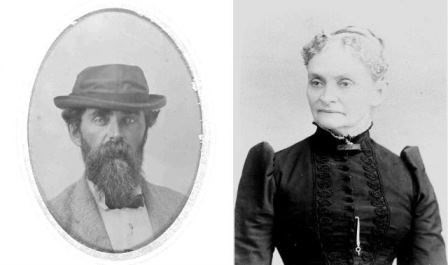
Charles W. Patterson took over the main light-keeping position from Uriah Smalley in 1861 and his sister Sarah was hired as an assistant six years later. Two years after that, Samuel P. Jewell also became a second assistant, working alongside Sarah.
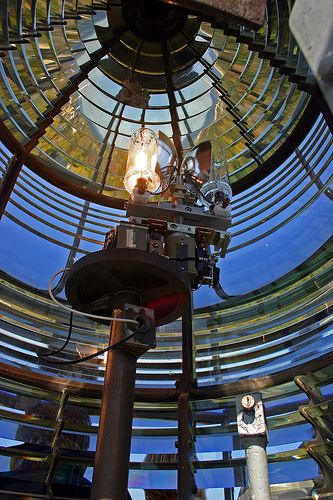
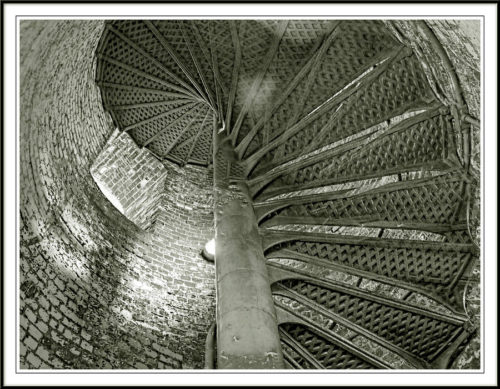
There was no doubt assistant lightkeepers were essential, since maintaining the beacon required a lot of work, time and care. It was important to keep a bright light regardless of the weather; the light was fueled with kerosene oil to keep the Fresnel lens bright, and the oil had to be carried up the stairs to the light….all 108 steps from the base to the top.
Sarah was born Feb. 29, 1832, married James Johnson in 1856 and had two children, both of whom died in infancy, and she was widowed not long after, later taking on the position of lighthouse keeper. Records show she was paid $360 annually for her post.
During his years as keeper, Sarah’s brother Charles lived at the light with his wife, W. Anker Patterson, and their four children, sons Trevonian, Franklin, and Edwin, and a daughter, Mary. His first keepers during his 24-year tenure were Frank and Austin Patterson. Charles resigned in 1885 due to Bright’s disease, so Sarah left her position as well, but remained on the Hook teaching the children of the soldiers at the relatively new Providing Ground. Mr. Jewell was promoted to become the lighthouse keeper, remaining for a total of 40 years, the longest of any of those keepers in the Sandy Hook service.
Sarah remained at Sandy Hook after leaving the lighthouse until all civilians were ordered off the base because of the Spanish-American War. She then retired to her hometown of Howell, where she died in 1909. Charles’ daughter Mary grew up and served 30 years with the US Life-Saving Service, Station Number 1, located at Sandy Hook, continuing a long-time family service to the sea.
Sarah lived through some interesting times on the peninsula. She saw the Sandy Hook Proving Ground officially established in 1874, was on the Hook in 1894 when the lights were first electrified, thanks to help from the Gedley Channel buoys which were electrically powered. She was still there in 1903 when the power was switched back to kerosene gas because the buoys were converted to gas. It was the same year a mortar exploded at the proving ground and 15 tons of metal poured down all over Sandy Hook.
Electricity was not returned to the lighthouse until 1925 and in 1941, the Sandy Hook Lighthouse came under the jurisdiction of the US Coast Guard.
Sarah Johnson died in 1909 and is buried at the cemetery of the Ardena Baptist Church, where she had been a lifelong member.
A plaque honoring Lighthouse keeper Johnson is situated at Sandy Hook near the lighthouse.
]]>Join the American Littoral Society’s expert birder, Dan Burgoyne, for mornings and evenings of birding along the coast as we explore Sandy Hook’s rich and diverse habitats.
We’ll walk through forests, marshes, and shoreline areas in search of shorebirds, wading birds, ospreys, terns, and more. Along the way, we’ll share bird ID tips and highlight Sandy Hook is an important habitat for wildlife.
Perfect for birders of all experience levels! Beginners welcome!
Sandy Hook Dates:
- Evening Bird Walk
- Wednesday, July 29 – 6:00 p.m.
- Sunset Birding & Whip-Poor-Will Walk
- Friday, July 31 – 6:00 p.m.
- Morning Songbird & Shorebird Walk
- Saturday, August 15 – 7:00 a.m.
- Sunset Birding & Whip-Poor-Will Walk
- Thursday, August 20 – 7:00 p.m.
- Morning Songbird & Shorebird Walk
- Wednesday, August 26 – 7:00 a.m.
- Evening Bird Walk
- Saturday, August 29 – 6:00 p.m.
Register through the links above or Contact: [email protected] for more information.
Charles Henry Lee was a British-born American army officer who served as a general of the Continental Army during the American Revolutionary War. He also served earlier in the British Army during the Seven Years’ War. He sold his commission after the Seven Years’ War and served for a time in the Polish army of King Stanislaus II Augustus.
Lee moved to North America in 1773 and bought an estate in western Virginia. When the fighting broke out in the American Revolutionary War in 1775, he volunteered to serve with rebel forces. Lee’s ambitions to become Commander in Chief of the Continental Army were thwarted by the appointment of George Washington to that post.
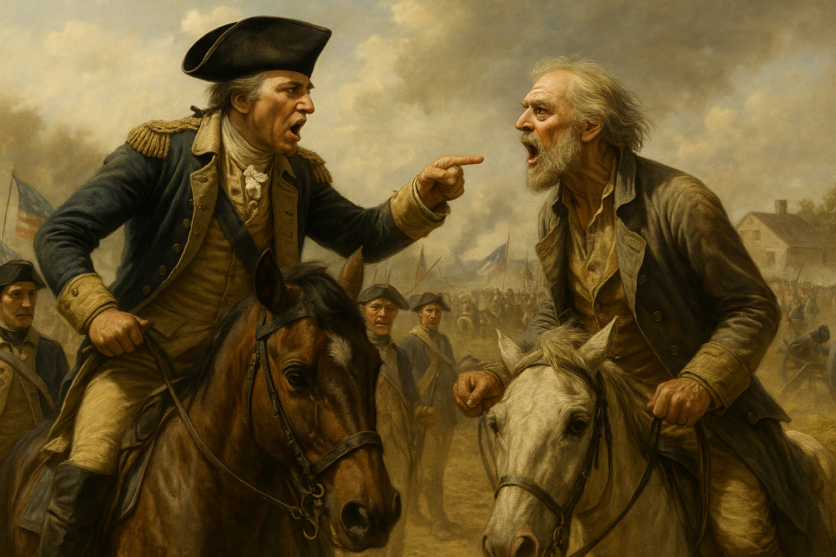
During the Battle of Monmouth in June of 1778, Lee led an assault on the British position and as Washington’s other units pressed the attack, General Lee ordered his units to retreat. Washington was so furious that he thundered onto the Battlefield and confronted Lee, the two Generals screaming at one another. Washington relieved Lee of command and had him arrested. General Washington rallied the fleeing troops and charged forward, taking command. Later, Lee was court-martialed and stripped of his rank and his duty to the Continental Army was terminated.
The Ghost
In Highlands, NJ, on moonless nights, residents claim to see a man in a tattered Revolutionary War uniform on horseback riding the hills, seemingly looking for a way to cross the Shrewsbury River. He seems to be in anguish, his expression of guilt and suffering. In 1904, local newspapers ran a story and collected testimony from fishermen who saw the ghost riding along the beach, looking out across Sandy Hook. Most believe the rider to be the spirit of General Charles Lee attempting to join the British at Sandy Hook,
but unable to cross. These sightings continue to this very day.
It was October 5, 1781. The privateer sloop Revenge ghosted along Raritan Bay in total darkness, making barely a ripple on the water. With all running lights extinguished, her black hull made her nearly invisible. Her Master was well versed at navigating the bays and rivers. Captain Adam Hyler needed no lights to guide his ship. Trailing on a towline behind the Revenge were two 36ft whaleboats.
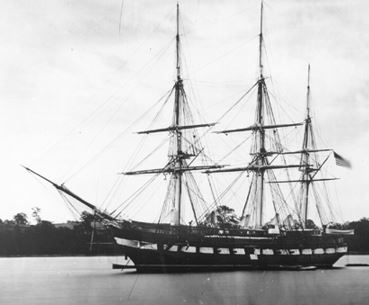
Hours earlier, a patriot courier had rushed into William Mariner’s tavern in New Brunswick and told Hyler that a convoy of potential prizes had anchored in Horseshoe Cove at Sandy Hook, under the protection, not only of the log fort’s swivel cannons, but a massive, 200ft British man of war, with 100 cannons spread across three tiers.
Adam knew what he was in for. As a young man, he had been pressed into service by the British Royal Navy, after which he became a ship’s captain with his own merchant shipping company. A life at sea made Hyler acutely aware of the awesome power of a British man of war.
Adam Hyler was born in Baden, Germany in 1735 and came to NJ with his family in 1752. By the time of the Revolutionary War, Hyler was in his 40’s and a well-respected businessman in New Brunswick. When war broke out, Adam joined forces with Captain William Mariner as second in command of Mariner’s privateer forces. After Mariner’s forced retirement, Hyler took over and his exploits became legend. The New Jersey Gazette reported his multiple, daring raids on the British stronghold at Sandy Hook. Headlines screamed his name.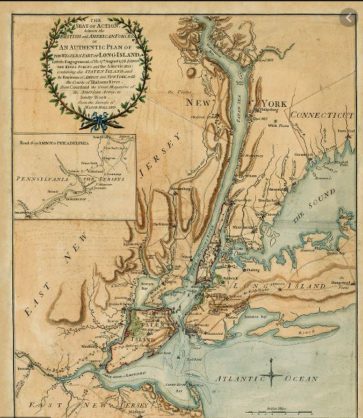
As the Revenge slipped into Sandy Hook Bay, Hyler could see his quarry. Sitting at anchor in Horseshoe Cove (Called Horseshoe Bay in 1781) were five prize ships. Three of the vessels were merchantmen, but the other two were armed Tory privateers. The smaller, a sloop, mounted a three-pounder cannon and six swivels; the larger carried four six-pounders, two on each side. They were more than a match for the Revenge and her whaleboats. Ashore, the raiding party faced the twelve swivel cannons mounted on the British Log Redoubt at the base of the Sandy Hook lighthouse, not a half-mile away on the beach.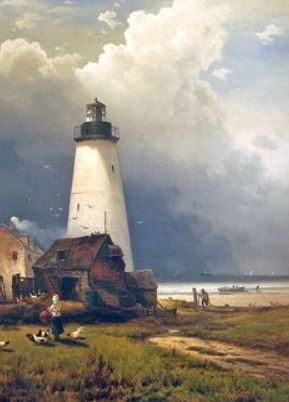
Hyler gave orders to have the whaleboats reconnoiter the prizes. His men slipped silently into their boats and rowed to their targets in total darkness. An old hand at naval battles, Adam had the oar handles and tholepins wrapped in leather to avoid any noise while rowing. His men, hand-picked because they showed no fear in battle, were like wraiths. Adam waited.
They returned to report that the merchant vessels were unmanned, and the Tory privateer’s night watch was haphazard at best. Hyler whispered to his second in command, “Battle Stations.” The whaleboats and the Revenge swooped down on their targets. The Revenge taking the larger privateer, while one of the whaleboats took the small privateer and the other began stripping the merchant vessels of all that was valuable. 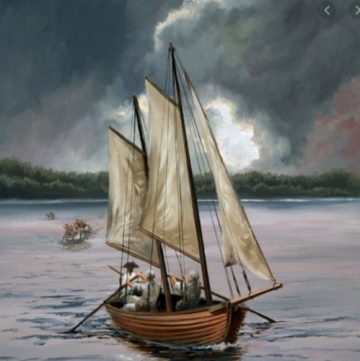
Hyler was the first onboard the Tory privateer, followed by his men. Their footfalls aroused the Tory crew. Only a few made it out from below deck as Hyler’s men guarded the door with cutlasses drawn. The Tories on deck decided to abandon ship rather than fight, they guessed the identity of their assailants. Hyler and his men stripped the vessel of valuable gunpowder and arms and set her ablaze. Their last act was to release the Tory crew. His whaleboats did likewise to all but one merchant vessel, where a woman and her children were found hiding in their cabin.
The fires aroused the British dreadnought. Shouts could be heard as guns were run out and cannons began to fire into the darkness. Hyler kept the Revenge behind the burning vessels, allowing no shadow or profile, so the Man of War had no target that night. Some say that the Revenge with her whaleboats in tow, slipped into the night and back to her homeport in New Brunswick.
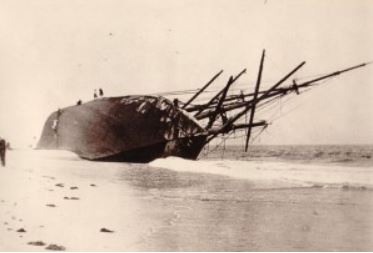
But another story tells us that Hyler took personal command of one of the whaleboats and silently slipped under the bow of the great warship as it continued withering fire at an invisible target. Once in position, Adam cut the ships anchor line so that the massive vessel was adrift, inching ever closer to shore with each volley of her guns, ending any chance that she could pursue the Revenge.
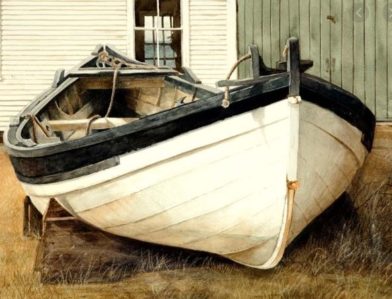
Hyler went on to harass British shipping for another year after this raid. He humiliated the British Navy and faced multiple assassination attempts by British forces. On May 25, 1782, he attacked and defeated a group of 25 British marines in a combined Naval and Land action, referred to as the Battle of the Shrewsbury River (fought either in Monmouth Beach or Rumson, NJ). Adam was severely wounded during the fight. Despite a wound that would not heal, Hyler went on to continue raiding and fighting against British forces until he died of his wounds several months later.
–
Hell Gate
It was November 23, 1780. The tide of war had turned, and British forces were facing the disconcerting reality that the French Army had joined General Washington, “the colonial.”
Sir George Brydges Rodney was taking his ships of the line south and decided that the British Army’s payroll, a payroll that included approximately $2-4 million in gold coins of back pay for its soldiers (hidden in barrels of chalk), be moved to anchorage off of Gardiner’s Bay on Eastern Long Island.
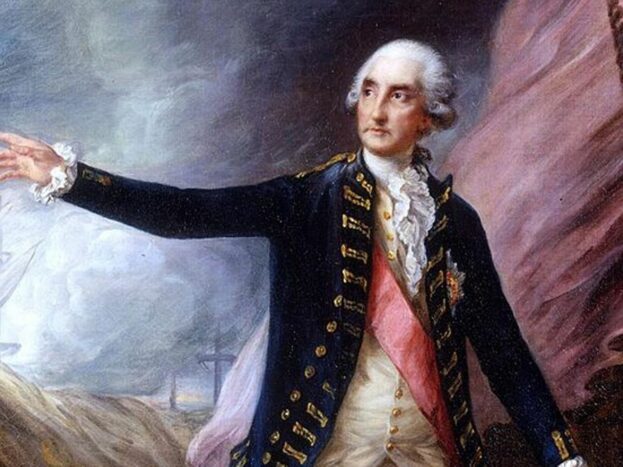
There it would be safe and could be distributed to the troops. In addition to the payroll and back pay, Hussar carried an additional cargo. In her dark hold were 70-80 American Prisoners of War, in chains.
The payroll was loaded onto the Mermaid Class Frigate, HMS Hussar under the command of Captain Charles Pole. Pole, though promoted to Captain only the year before, had seen action at the siege of Pondicherry in India in October and had been Second-in-Command of the Channel Squadron, under Admiral George Darby.
During that afternoon’s briefing, the pilot of Hussar, an enslaved man named Swan, advised Captain Pole against traversing the treacherous narrow tidal strait, known as Hell Gate, located in the East River in between Queens and Ward’s Island at the center of a confluence of the New York Upper Bay, Long Island Sound, and the Hudson River (via the Harlem River). It runs the span of today’s Manhattan’s 90th Street to 100th Street.
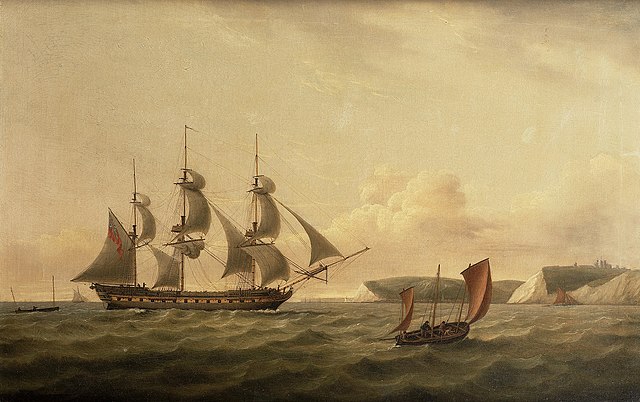
Pole brushed aside the Pilots concerns and the 647-ton, 124-foot Hussar, loaded with gold and human misery in her holds and sporting 28 cannons and 12 swivel cannons began to move along the East River.
As she approached Hell Gate the current began to pick up speed, and eddys turned to whirlpools. Rocks loomed everywhere. The ship began to tremble as competing currents slammed into her on all sides like wild beasts attacking prey. She was not responding to the helm; Swan hung his full body weight on Hussar’s wheel and cursed ferociously. But not even his creative swear words could save the ship. Hussar slammed hard into Pot Rock, a giant boulder in the center of the strait and was mortally wounded.
Captain Pole ordered Swan to “run her to ground”, but the current was relentless. Hussar, her gold, her colonial prisoners, and her glorious naval past, sunk in 96 feet of water at Hell Gate, on November 23, 1780. All her crew and officers and her enslaved pilot, Swan, survived. The men chained below deck did not.
The Dreamer
Simon Lake was born in Pleasantville, NJ on September 4, 1866, of Miriam Adams and Christopher John Lake. His father was an inventor and a developer of Atlantic City and Ocean City. Simon, named for his paternal Grandfather, who was one of the founders of Atlantic City and Ocean City, acquired his passion for engineering working in his father’s foundry and workshop. But his real inspiration was a copy of Jules Verne’s 20,000 leagues under the sea. Lake passionately read that book until his copy was hopelessly worn.
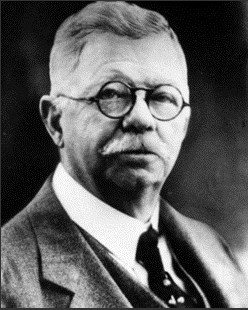
Growing up, Simon attended high school at Toms River NJ, then went on to study engineering and Naval Architecture at the Clinton Liberal Institute in New York, and the Franklin Institute in Philadelphia. Afterward, he found himself winding gears for oyster boats in Baltimore. But he still dreamt of Captain Nemo and the Nautilus flying through the ocean depths. “What a world we’d have if we could travel under the sea.”
In 1893, Lake read that the United States Navy was requesting designs for a submarine torpedo boat. He read the specifications and, though nervous, left his job in Baltimore. His Uncle, Somers Townsend Champion and his wife Anna Margaret Lake invited Simon to live with them in Atlantic Highlands, NJ. It would be perfect for him.
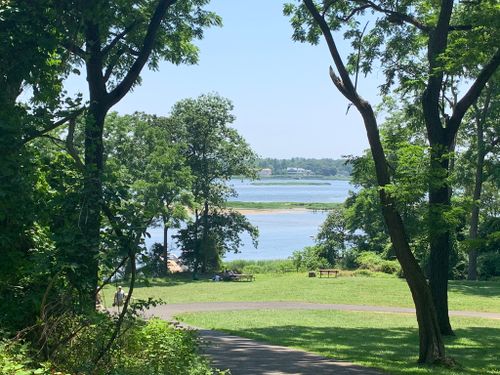
They lived on Sandy Hook Bay, there were two rivers, the Shrewsbury and the Navesink, all of which were reasonably shallow. He could build and test his submarine there. So, Simon took a deep breath, headed north, and sank into his dream
Money Makes the world go around, the world go around.
“Sime, I’ll help you, but this will cost a fortune to build. Where will we get the money?” was Bart Champion’s lament when Simon told him of his plan to compete for the Navies contract. Lake knew that building this submarine would be expensive. The design lived in his head. He knew that he could do it and that once built and demonstrated, his entire world would change. He was on the cusp of a great adventure, just like the heroes in Verne’s novels.
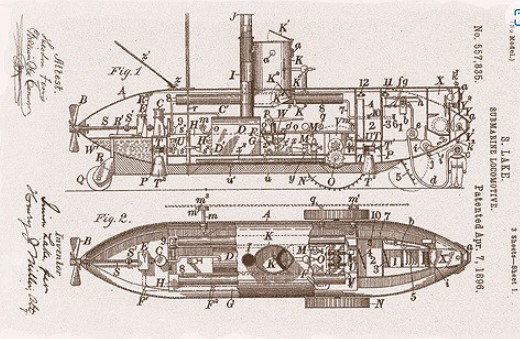
But iron was expensive, and so would be the fabrication of the vessel. He looked out his Uncle’s window at Sandy Hook Bay for a long while. After a time, a smile crossed his face. “Bart, we’ll build her out of wood! Just like an old sailing ship, wood and resin and pitch! This way we can afford it!” Bart Champion, Simon’s cousin, burst out laughing. “Sime! You’re mad. Stark raving mad! But I must be as well because I think it’s a great idea!”
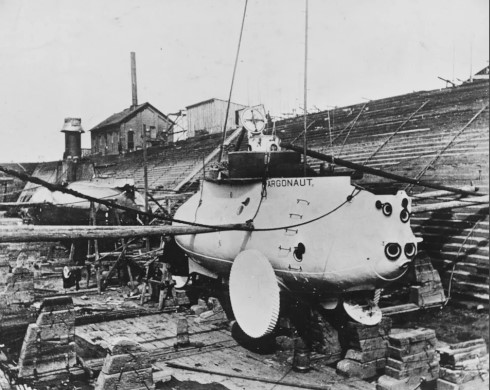
For a year, the two cousins worked on what Simon Lake would later call “Argonaut, Jr.” He chose the name as it is that of a small floating octopus, the female of which has webbed sail-like arms and secretes a thin coiled papery shell in which the eggs are laid. The animal looks similar to the Nautilus. The animal which inspired the name of Captain Nemo’s submarine in 20,000 Leagues Under the Sea.
In December of 1894, Simon and Bart transported the Argonaut Jr. to Blackfish Cove, off Rocky Point at Hartshorne Woods. There the usually calm water was 20 feet deep and ideal for testing a homemade, wooden submarine.
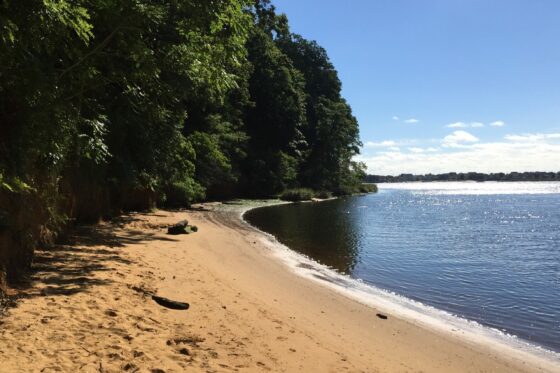
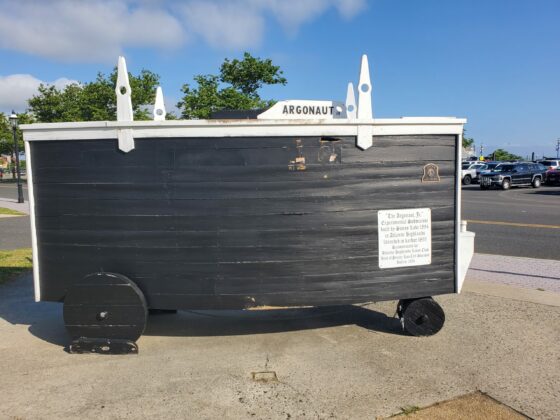
Argonaut Jr. had several innovative features. “When submerged to a shallow seafloor, a diver’s door could be opened, and he could retrieve articles or exit and re-enter the little 14- foot submarine by maintaining a pressurized compartment.” In addition, Argonaut Jr. had wheels to roll her across the bottom and prevent her from becoming stuck in the mud. She moved via a hand crank. Once submerged, she rode across the river bottom as the two submariners watched riverine creatures through the porthole. Just like Professor Aronnax had done in Jules Verne’s novel.
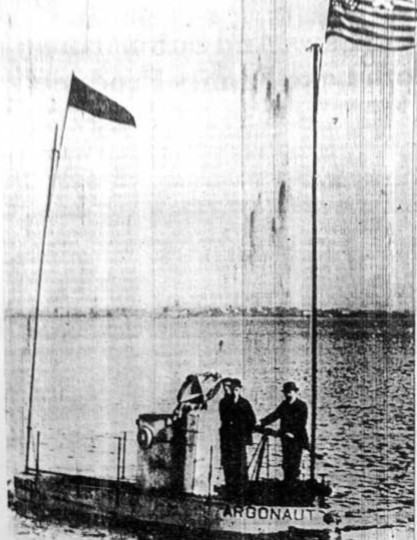
The success of their maiden voyage left young Simon positively giddy. He devised a demonstration that, he believed, would get Argonaut noticed. He set up a demonstration at the Atlantic Highlands harbor for the press, dignitaries and townspeople. Argonaut submerged and , after a while, surfaced with Lake producing a handful of starfish and clam shells.
Expecting accolades, he was crestfallen when the crowd accused Lake of planting the creatures on board prior to the dive. Lake’s uncle Somers Champion took over. He persuaded the Mayor and council members to sign a shingle and throw it into the harbor. Once again, the little boat submerged, and a while later surfaced with the single. The crowd cheered. The press dismissed the demonstration as a publicity stunt.
In the end, Simon did not win the navy contract. However, he is responsible for over 200 submarine-related patents. He designed and sold his submarines to both Russia and Germany and, eventually the US Navy.
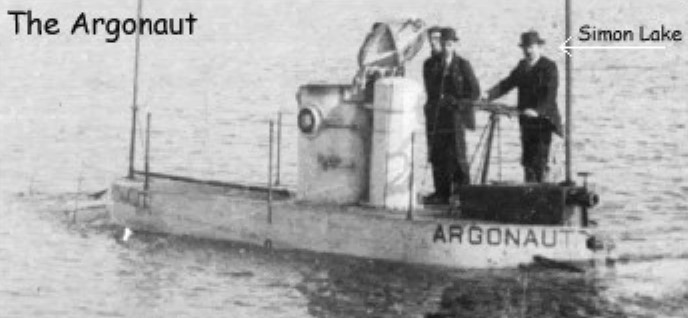
Simon Lake is credited with the development of groundbreaking submarine technologies for the safe and successful operation of submarines. These technologies include even-keel hydroplanes, ballast tanks, divers’ compartment, the periscope, and the double-hull design. He also was the first person to take a photograph and the first to film a movie underwater.
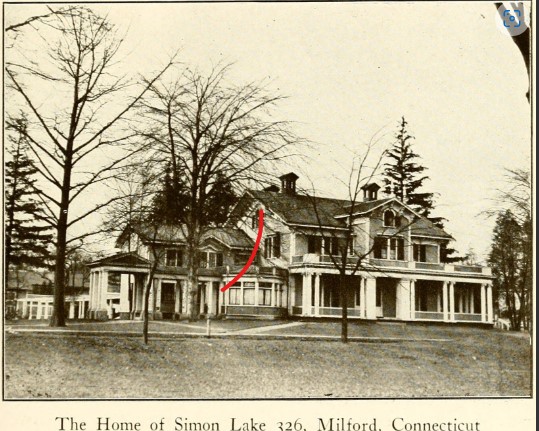
Lake became a wealthy industrialist and moved to a large house in Milford, Ct. This is where the story should end with the sentence “and Simon and his family lived happily ever after.” But Simon became obsessed with the wreck of the HMS Hussar and her lost payroll. His submarines would find Hussar and salvage her cargo, he told the New York Times.
In 1934, Lake began his quest for Hussar in the East River. He worked Hell Gate in his submarine for two years. And then the money began to run out. He was sued by a deckhand for, ironically, back pay of $394. One afternoon, Simon called reporters to his office. “If I were a betting man, I would lay 100 to 1 the Hussar has been found at last. For fifty years I have been speculating on the likelihood of locating this ship and within six weeks I expect to step within her hold. Now, nobody can tell what gold there is. It’s not the gold so much as the satisfaction of solving a riddle, though some gold would do no harm.”
On September 4, 1936, Simon Lakes 70th birthday, he, apparently, found the Hussar. His auger-like probe came back with wood and chalk embedded on its coils. But it was not to be.
He was sued again. This time his house was in foreclosure for the sum of $1800.00. He lost his house in November of 1937. In his autobiography, Lake said “No one now knows precisely where the old hulk rests, and my explorations early in 1937 were unsuccessful. I have not given up the idea, but other things are more pressing.”
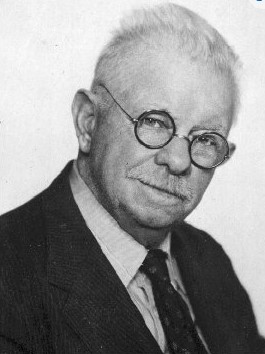
Fate can be cruel. Simon Lake passed away on June 23, 1945. He never got to officially find the HMS Hussar. His obituary read:
“Simon Lake, Builder of First Successful Sub, Dies at 78
Inventor Always Saw Undersea Craft as Peace Instrument
By the Associated Press.
BRIDGEPORT, Conn., June 23.
Simon Lake. father of the modern submarine died tonight in ‘St. Vincent’s Hospital here after a brief illness. He was 78.
Simon Lake’s inspiration for developing the modern submarine came directly from Jules Verne’s “Twenty Thousand Leagues Under the Sea.” which Mr. Lake read avidly when he was a boy of 10.
He kept thinking about submarines. and doing something about them, almost to the end of his life. He never lost faith that watercraft would be used as instruments of peace.”
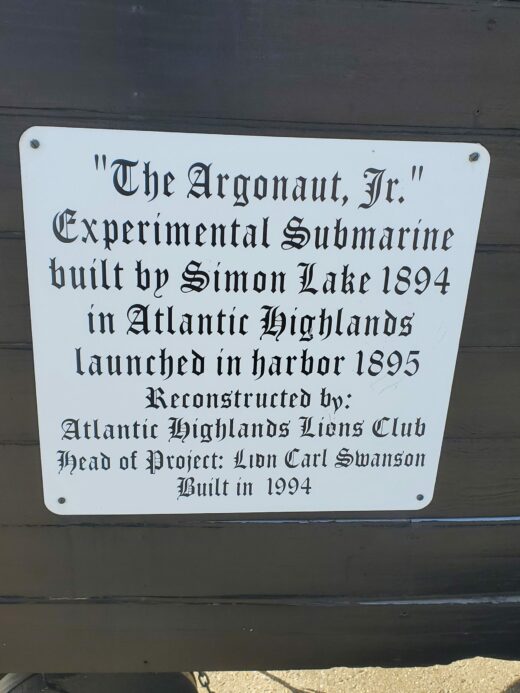
Today you can see a replica of Argonaut Jr. in the Atlantic Highlands Municipal Harbor. It was constructed by volunteers from the Atlantic Highlands Lions Club and donated to the harbor in 1994.
Bart Champion might have been correct when he told Simon that he thought him mad. But you decide.
“A dreamer is one who can only find his way by moonlight, and his punishment is that he sees the dawn before the rest of the world. Dreams have only one owner at a time. That’s why dreamers are lonely. The dreamers are the saviors of the world.”
-Oscar Wild
]]>
It was April 15, 1908. Private Lander Radford was on duty in building No. 32 at Fort Hancock, Sandy Hook, NJ. It had been a normal day, full of the typical duties of a U.S. Army Private. That changed when a group of men barged through the door carrying large wooden boxes with a ghastly cargo of skeletal remains. Radford regained his composure to ask the men what had happened. They had been working near Horseshoe Cove, grading the new railroad bed when they came upon an obstruction. As they dug around it, they realized that it was a vault made of bricks and contained 14 bodies.

The remains that the workmen discovered on that sunny April day belonged to Lt. Hamilton Douglas Haliburton and 13 crew members of the 50-gun, Portland-class British Warship, HMS Assistance. Private Radford would later report: “We were told that 14 Bodies were found in a forgotten burial, so we were ordered to make 14 wooden boxes to hold each body. But the trouble was that all the bones were mixed together in the boxes brought to the storehouse. We couldn’t tell who was who, so when we made the boxes, we did our best to try and figure out if we had enough bones for each body, and then put them into each box.”

The remains were reinterred at Cypress Hills National Cemetery in Brooklyn, New York in 1909, and a large, granite monument was erected over their grave in 1939.
December 31, 1783, the American Revolutionary War was essentially over. The HMS Assistance lay at anchor in Horseshoe Cove at the British stronghold of Sandy Hook. It was cold and the sky was a deep grey with the smell of impending weather in the air. Earlier that day, a Midshipman and 6 crew members set off in a longboat to retrieve water from the nearby transport ship, HMS Bridgewater. The crewmen overpowered the Midshipman and pulled for the town of Portland Poynte.
Captain William Bentinck had a problem. The day prior, 5 seamen jumped ship and deserted. It was becoming an epidemic. Given that the Assistance had a complement of 350, he could not afford desertions. His reputation and career were at stake. After some deliberation, he summoned 20-year-old Lieutenant Hamilton Douglas Halyburton and gave him orders to select a contingent of officers and chase down the deserters. Halyburton, a 7-year Naval veteran and member of the peerage, was a rising star in the Royal Navy. Bold, dynamic and eager to make a name and career for himself, he was the perfect choice to lead the mission.
Hamilton chose thirteen men, 12 officers and a seaman, for the duty. They boarded the ship’s barge as the grey sky darkened and a breeze began to stir. They set off to find the latest group of deserters.
Later that night, the breeze blew into a full-on gale with a heavy snowfall. Captain Bentinick began to be concerned as the weather continually worsened. He hoped that Halyburton and his men had made it to shore before the blizzard began.
The blizzard and gale-force winds continued all the next day. On January 2, 1784, the barge and frozen bodies of Hamilton Douglas Halyburton and his 13 men (James Champion Lieutenant of Marines, Alexander Johnstone, George Paddy, Robert Haywood, Midshipmen, Charles Gascoigne, William Tomlinson, Andrew Hamilton, William Spry, William Scott, John McChain, David Reddie, Robert Wood and George Towers common seaman) were discovered grounded on a mud bar, stuck fast. Had they landed 150 yards in either direction, there is a good chance they would have survived, as the barge would have been able to return to the ship.

Katherine Hamilton, the Countess Dowager of Morton, erected a marble monument over the grave of her son and his men at Sandy Hook.
In or about 1808, during the Napoleonic Wars, an armed French Corsair landed on Sandy Hook in search of water. Some of the crewmen took the time to destroy Halyburton’s monument.

In 1937, the Civilian Conservation Corps erected a new memorial, made of local peanut stone, over the site of the grave near Horseshoe Cove. A bronze plaque relates the story of the HMS Assistance tragedy.
The Assistance ended her naval career wrecked on a sandbar off Dunkirk in 1802.
https://nyharborparks.org/visit-parks/#tab-id-23
]]>