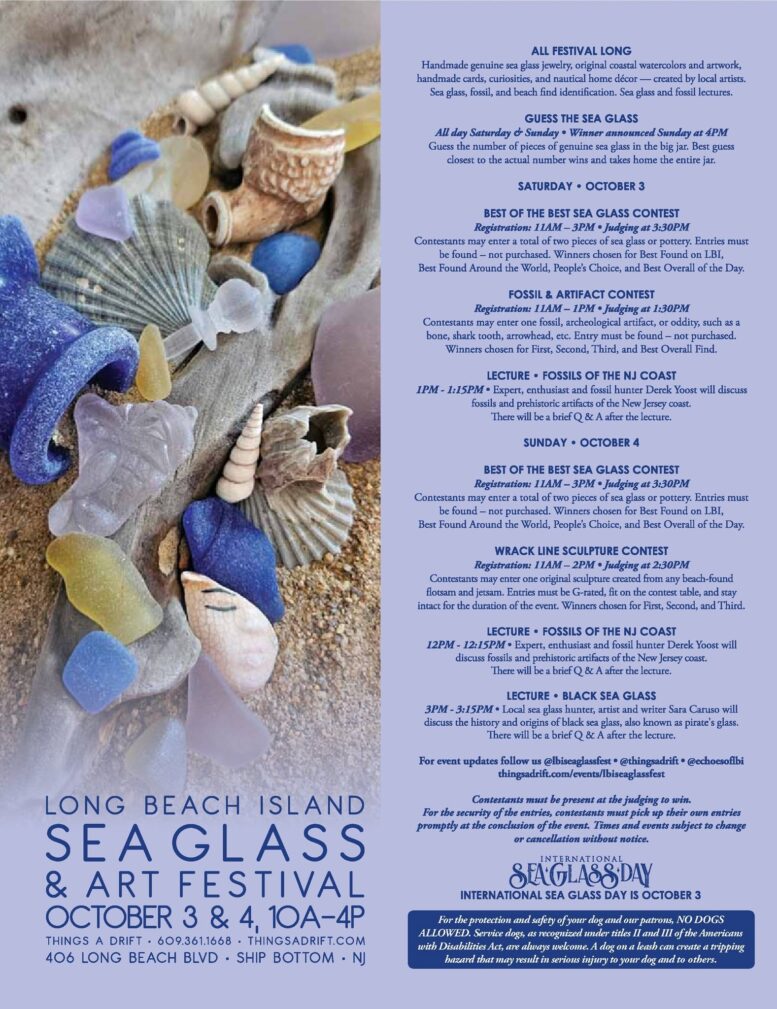
Location: Things A Drift, 406 Long Beach Blvd, Ship Bottom, NJ 08008
All day Saturday & Sunday • Winner announced Sunday at 4 PM – Guess the number of pieces of genuine sea glass in the big jar. Best guess closest to the actual number wins and takes home the entire jar.
Registration: 11 AM – 3 PM • Judging at 3:30 PM. Contestants may enter a total of two pieces of sea glass or pottery. Entries must be found – not purchased. Winners chosen for Best Found on LBI, Best Found Anywhere Outside LBI, Best Overall of the Day, and the People’s Choice Award.
Registration: 11 AM – 2 PM • Judging at 2:30 PM. Contestants may enter one fossil, archeological artifact, pottery, or oddity. Entry must be found – not purchased. Winners chosen for First, Second, Third, and Best Overall Find.
1 PM – 1:15 PM • Expert, enthusiast, and fossil hunter Derek Yoost will discuss fossils and prehistoric artifacts of New Jersey. There will be a brief Q & A after the lecture.
Registration: 11 AM – 3 PM • Judging at 3:30 PM. Contestants may enter a total of two pieces of sea glass or pottery. Entries must be found – not purchased. Winners chosen for Best Found on LBI, Best Found Anywhere Outside LBI, Best Overall of the Day, and the People’s Choice Award.
Registration: 11 AM – 2 PM • Judging at 2:30 PM. Contestants may enter one original sculpture created from any beach-found flotsam and jetsam. Entries must be G-rated, fit on the contest table, and remain intact for the duration of the event. Winners will be chosen for First, Second, Third, and Best Overall.
12 PM – 12:15 PM • Expert, enthusiast, and fossil hunter Derek Yoost will discuss fossils and prehistoric artifacts of New Jersey. There will be a brief Q & A after the lecture.
3 PM – 3:15 PM • Local sea glass hunter, artist and writer, Sara Caruso, will discuss the history of black sea glass (pirate’s glass) and how to find it. There will be a brief Q & A after the lecture.
-
- Fluke (Summer Flounder): The 2026 fluke season is in its final countdown and official closes on September 25. Anglers are currently pulling in massive “doormat” fluke by fishing deep ocean wrecks, reefs, and inlets.
- Striped Bass & Bluefish: The highly anticipated fall run is just starting. Smaller resident striped bass and hungry bluefish are active in the surf and back bays, especially during early-morning “first light.”
- Exotic & Speed Species: Warm water temperatures have brought fun, fast-moving fish close to the beaches. You can target Bonito, Spanish Mackerel, and False Albacore right from the inlets or inshore boats.
- Crabs & Bottom Fish: Back bays are full of action for Blowfish, Sheepshead, and Tautog (Tog) around bridges and sod banks.
-
- Inlets: Manasquan Inlet, Barnegat Inlet, and Shark River Inlet act as “highways” for migrating fish moving in and out of the bays.
- The Surf: Beaches in Lavallette, Seaside Park, and Long Beach Island offer plenty of room for surf casting without swimmers in the way.
- Ocean Reefs: For keeper fluke, head out on a charter or party boat from Belmar or Point Pleasant to hit the structural wrecks.
- Beat the clock for fluke: If you want summer flounder, you must get out before the season ends on September 25th. Use heavy bucktails tipped with Berkley Gulp or live minnows.
- Fish early or late: Hit the water during sunrise or sunset when predatory fish like stripers and bluefish push bait up against the sod banks and jetties.
Here are three reasons for you and your family to go fishing for your next day trip:
1. It’s a fun way to spend time together.
Fishing is a fun activity that gets kids outdoors and engaged, and it’s easy for anyone to participate, regardless of their age. Fishing allows friends and families to enjoy a relaxing day together and helps keep their focus on each other, nature and the activity at hand. For kids interested in fishing on a regular basis, organized youth fishing programs are becoming increasingly popular nationwide.
Many people live near lakes or other bodies of water, allowing easy access to the sport. For others, water may be just a short drive away, making for a perfect one-day escape or weekend getaway.
2. Fishing isn’t complicated to learn and doesn’t require a ton of expensive equipment.
Whether you own or rent a boat, or fish from a dock or shoreline, learning the basics with an affordable rod and reel is something anyone can do. Also, there are plenty of lure options that make fishing a quick and fun pursuit for any skill level.
3. It’s good for you.
Spending time outdoors offers significant health benefits. One huge advantage of fishing together is that it allows families to get away from screens. Everyone can set their phones and gadgets aside to enjoy time in nature and relish each other’s company without distractions.
If a child is spending too much time with electronics, breaking up their routine with an outdoor activity like fishing can expose them to the benefits of in-person interaction, engaging with the real world and experiencing the beauty of nature.
Here are additional health benefits that come with fishing outdoors:
Vitamin D. Just 10-15 minutes of midday sun provides a healthy dose of vitamin D, which helps bodies absorb calcium. This boosts bone growth and health and fights disease. Vitamin D also elevates mood, helping with depression.
Relaxation. Being outdoors, breathing fresh air and spending time on a body of water relieves stress and lowers blood pressure. For people constantly on the go, it’s a great way to take a much-needed break.
Exercise. Walking and boating help burn calories and increase heart rate. And even though the participants may not notice, fishing helps stretch and flex some of the body’s underused muscles.
With its widespread accessibility, health benefits and ease of participation, fishing is a great way to get outside and enjoy the beautiful summer weather ahead. You just might catch some fish – and have a great time doing it.
]]>- 2 pieces thick-cut bread
- 1 large ripe avocado
- 1/2 cup canned cannellini beans, drained and rinsed
- 1 tablespoon freshly squeezed lemon juice
- kosher salt, to taste
- freshly cracked black pepper, to taste
- 1 tablespoon hemp hearts
- 1/2 cup diced cherry tomatoes
- 1 tablespoon olive oil
- 1/2 tablespoon red wine vinegar
- 1 tablespoon chopped fresh basil
- 2 eggs
- Hot sauce or red pepper flakes (optional)
Our country was truly UNITED on the days that followed as we searched for lost loved ones and began the arduous task of recovery and rebuilding. There are countless stories to tell and they should be told. One that stood out to me, a lifelong tree-hugger, was the story of “The Survivor Tree”
A callery pear tree became known as the Survivor Tree after enduring the September 11, 2001, terror attacks at the World Trade Center. In October 2001, the tree was discovered at
Ground Zero, severely damaged, with snapped roots and burned and broken branches. The tree was removed from the rubble and placed in the care of the New York City Department of Parks and Recreation.
After its recovery and rehabilitation, the tree was returned to the Memorial in 2010. New, smooth limbs extended from the gnarled stumps, creating a visible demarcation between the tree’s past and present. The tree stands as a living reminder of resilience, survival and rebirth.
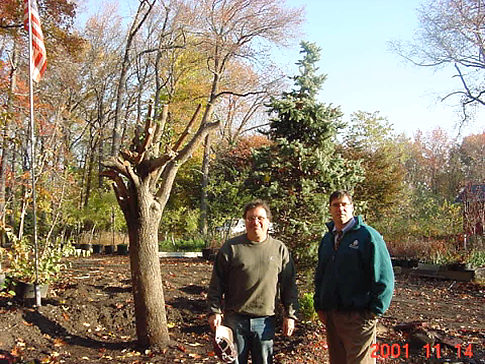
Photo courtesy of the city Parks Department.
The 9/11 Memorial began a tree seedling program on Sept. 11, 2013, in partnership with Stamford, Conn.-based Bartlett Tree Experts and John Bowne High School in the Flushing
neighborhood of Queens, N.Y. John Bowne High School cares for the seedlings as part of the school’s agriculture curriculum.
Seedlings have been shared with communities around the world that have endured tragedy. Recipient communities have committed to nurturing these trees to serve as landmarks symbolizing resiliency and hope.
In 2022, recipients included:
• Ukraine, to honor the thousands of Ukrainian casualties from the unprovoked war with Russia.
• Buffalo, New York, the site of a mass shooting, which killed 10 people and wounded three.
• The community of Miami-Dade County, Florida, the site of a residential condominium collapse, which killed 98 people in the small, beachside town of Surfside.
Past recipient communities include the WHO, Oslo and Utøya, Norway, Santa Fe, TX, the Bahamas, Christchurch, New Zealand, five NYC hospitals, Parkland, FL, London, U.K., Puerto Rico, Newtown, CT, Joplin, MO, Madrid, Spain, Far Rockaways in Queens, NY, Prescott, AZ and Boston, MA.
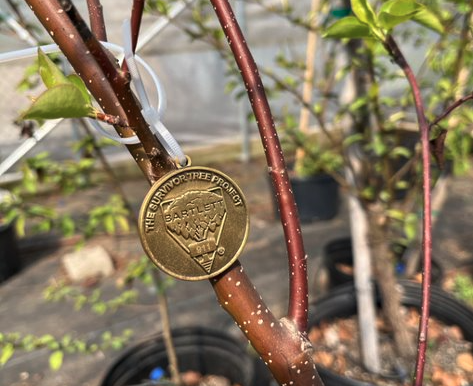
Learn more about the Survivor Tree and the seedling program here.
Cover photo by Jin S. Lee
]]>What is there to be learned 17 years after this tragic day?
I was a school principal on 9/11, in the small New Jersey community of Fair Haven, an hour south of Manhattan. As the shocking events of that day unfolded, there was no road map to guide me. I went from classroom to classroom to let teachers know what was happening and find out who might be worried about a family member or friend. Some of my words surely came out wrong.
I knew not to say, “I know how you feel,” because I clearly didn’t. One teacher’s husband was missing for hours. Two children had lost their fathers, their mothers lost husbands, and neighbors lost friends. Nothing in my life came close to that tragedy.
Sometimes words aren’t needed.
The moments following that day, when I didn’t say anything at all, are the ones that were my teacher. I had no words to stop the tears of a crying child as she felt the loss of her father, so I held her tightly on my lap as they flowed. When her mother cried, I placed my hand gently on her knee as if to say, “It’s O.K. to let it out. I’m here to hold your pain.”
Being with families who were dealing with such turmoil and loss left me wordless. When the right words didn’t materialize, I saw that words were not the only thing that mattered.
My own smaller loss.
It could be that my own life situation made me more vulnerable and open during this time. Just a few months before 9/11, I was diagnosed with breast cancer. When I hung up the phone after hearing my doctor’s diagnosis, my husband held me on his lap while I cried. I can’t remember what he said, though I’m sure his words were comforting. What I remember most is his presence, the feeling of his arms holding me tightly, and the security it gave me that he would go through whatever was to come with me.
I don’t mean to minimize words. They matter very much too. On the phone with my doctor on that fateful day, I remember her words vividly. “You’re very lucky,” she said in a soft, caring voice. At the time, her words were incongruous. “How could I have cancer and be lucky?” I wondered. Her words stayed with me and their meaning became clear over time—I am lucky to have survived.
But, before 9/11 and my illness I hadn’t felt the power of presence in such a deeply moving way, leading me to this lesson:
In the years following loss, people remember that we were there, maybe even more than they remember what we might have said.
So, I’d say that while words are very important, the presence of someone who can hold our pain without trying to fix it can be even more profound and lasting. What would you say?
]]>To help you prepare and keep your pet safe this winter, here are three safety tips for pet parents:
1. Pet allergies need a quick response
Just like their pet parents, dogs and cats are prone to seasonal allergies. Data from last fall (Sept. – Nov. 2023) found atopy, commonly known as pet environmental allergies, was the most common pet insurance claim during this season – implying heightened veterinary visits and prescriptions needed.
Prevention is key. Look out for common, fast-emerging allergy symptoms such as sneezing, watery nose or eyes, skin irritation and inflammation. On the surface, these symptoms may not seem like a big deal. But when left untreated, they can easily lead to larger issues such as inflamed and irritated skin, hot spots (for dogs) or even hair loss and bleeding in more severe cases. If your dog or cat has allergies, try to identify allergy triggers and visit a veterinarian for proper treatment.
2. Dress for success
As the weather shifts to cooler temperatures and you start bringing out your sweaters, it’s a good time to take stock of what clothing your pet may also need. This is especially important if you live in a cold climate or your furry friend shivers outdoors. Check your local pet stores for jackets, rain jackets or sweaters for your dog or cat to wear to keep them warm during the colder months.
Halloween is also quickly approaching. When picking out your pet’s cute costume this year, make sure it’s also cozy and safe! Look for costumes and outfits that fit properly and don’t restrict their movement, hearing or breathing. Make sure to steer clear of dangling pieces or extra parts, which can pose a choking hazard or cause a throat blockage if ingested.
3. Prevent accidental escapes
Fall is a busy season, between children heading back to school and the holiday season just around the corner. People are constantly coming in and out of the house as a result, so it’s particularly important to keep a close eye on your pet’s whereabouts to prevent an accidental escape and injury. Some key spots to consider are your front door, garage door and backyard – especially if it isn’t gated.

To ensure your pet isn’t lingering by an exit point as you and your guests come and go, designate a safe, comfortable play space for them to go to, along with some of their favorite toys for distraction. A pet or baby gate may also be helpful to prevent these accidental escapes. Additionally, don’t forget to inform your guests about your pet so they can be more cautious when arriving and leaving.
While some preventative measures for protecting your pet this fall can be costly, you can consider taking measures to help offset some of the costs of health issues such as allergies or accidental injuries.
]]>Ingredients:
3/4 cup pure pumpkin puree
3/4 cup part-skim ricotta cheese
1 1/2 tablespoons maple syrup
1/2 teaspoon cinnamon
1/2 teaspoon vanilla extract 1 pinch of nutmeg (plus more for garnish)
1 pinch of salt
¼ cup plain Greek yogurt (for garnish)
Preparation:
- Combine pumpkin, ricotta cheese, maple syrup, cinnamon, vanilla extract, nutmeg, and salt in a small bowl; whip until fluffy and all ingredients are fully incorporated.
- Refrigerate at least 30 minutes prior to serving, to allow the mousse to firm up.
- Serve individual portions topped with 1 tablespoon full-fat plain Greek yogurt, chopped almonds, and a sprinkle of nutmeg.
Cooking and Serving Tips
This recipe requires very little hands-on time, so try something fun to spice up the presentation. A small wine or martini glass filled with this delicious mousse and abundant toppings is an extra fun way to do dessert.
Total Time: 5 min Prep Time: 5 min
Nutrition Highlights (per serving) 136 calories, 6g fat, 13g carbs, 8g protein
]]>
Over the past 19 months, the nation has witnessed a deliberate erosion of democracy and human rights under the current administration. “We The People Walk For Democracy” is meant to unify our voices to safeguard our democracy and to raise awareness about voting, while teaching young people the importance of being civically engaged.
Please join us for this walk, which is FREE to the public, with a mapped-out route from Riverside Gardens Park to the T. Thomas Fortune Cultural Center. However, you must register, and with a $35 donation, you will receive a “We The People” T-shirt, button, and sign.
Speakers include: Rev. Kerwin Webb, Chairman of the Board of the T. Thomas Fortune Foundation and Monmouth County former judge, the Honorable John D’Amico, along with the Fortune Tellers, youth tour guides who work at the Cultural Center. We are garnering community support and look forward to more organizations joining us on this walk.

Thomas Fortune was a man of action, and as the prominent editor of the New York Age, he was a significant member of the Black Press, which changed the social, political, and economic landscape of America. In 2027, the Cultural Center will commemorate and celebrate the Bicentennial of the Black Press.
Our mission as a non-profit organization is to uphold the civil rights and social justice legacy of T. Thomas Fortune through education, the arts, public programming and community outreach.
The following community organizations stand in support of “We The People Walk For Democracy.”
Lunch Break
Grunin Foundation
Pilgrim Baptist
The United Methodist Church of Red Bank
Two River Theater
Project Write Now
League of Women Voters
Following the walk, there will be light refreshments, music, and continued fellowship. Please visit our website www.tthomasfortuneculturalcenter.org to register.
]]>In 1884, the first Monday in September was designated as the holiday, as originally proposed, and the Central Labor Union urged similar organizations in other cities to follow New York’s example and celebrate a “workingmen’s holiday” on that date. The idea spread with the growth of labor organizations, and in 1885, Labor Day was celebrated in many industrial centers of the country.
Founder of Labor Day
More than a century after the first Labor Day observance, there is still some doubt as to who first proposed the holiday for workers.
Some records show that Peter J. McGuire, general secretary of the Brotherhood of Carpenters and Joiners and a co-founder of the American Federation of Labor, was the first to suggest a day to honor those “who from rude nature have delved and carved all the grandeur we behold.”
But Peter McGuire’s place in Labor Day history has not gone unchallenged. Many believe that Matthew Maguire, a machinist, not Peter McGuire, founded the holiday. Recent research seems to support the contention that Matthew Maguire, later the secretary of Local 344 of the International Association of Machinists in Paterson, N.J., proposed the holiday in 1882 while serving as secretary of the Central Labor Union in New York. What is clear is that the Central Labor Union adopted a Labor Day proposal and appointed a committee to plan a demonstration and picnic.
Labor Day: What it Means
Labor Day, the first Monday in September, is a creation of the labor movement and is dedicated to the social and economic achievements of American workers. It constitutes a yearly national tribute to the contributions workers have made to the strength, prosperity, and well-being of our country.
On Labor Day, the U.S. Department of Labor celebrates and honors the greatest worker in the world – the American worker.
https://www.dol.gov/general/laborday/history
]]>